
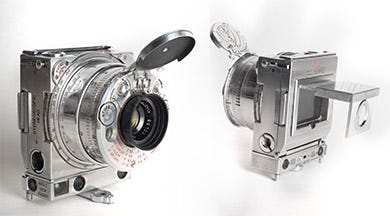
Le Coultre Compass Camera
One unstable inventor, five plate holders, and a prayer.

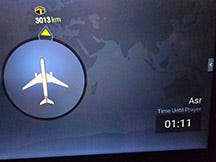
The Turkish Air “My Flight” screen presents the world to me. The airplane in which I am a passenger appears oversized and cartoonish above the earth. The screen lists the stats: Time Since Take-off; Time Until Landing; Time Until Prayer: one hour and eleven minutes. It’s dark in the large cabin and the drone of the engines has faded to background noise. I give my nearby seat mates the side-eye … “time until prayer”? What does Turkish Air know that we don’t?
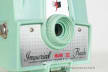
I’m on a journey with a couple of camera sidekicks. A pilgrimage of sorts, with an odd couple: a Le Coultre Compass Camera and a Conley Kewpie 3A Box “Postcard” type camera. We’re headed to Slovenia to explore and use vintage photographic processes focusing on photographic dry plates – both glass and metal.
On the flight from Seattle to Istanbul, my mind wanders. (But not too far, considering I only have 1 hour and 11 minutes ’til I need to pray.)
I have time to consider my purpose in life … I feel a camera must function. Maybe not as originally intended, but it must make an image. There are cameras I have gone to great lengths to wrestle an image out of. I’ve sweated and bled in the dark. I’ve cut film and paper in crazy shapes and sizes. I’ve frozen fingers, gotten blisters from cranking winding knobs, and experienced double vision from tiny almost non-existant viewfinders. I don’t think a camera has sent me to the walk-in clinic, but this Compass Camera sent me half way around the world.
How does someone with a $12 spending limit end up owning a camera like the Compass? I had been my friend, Ann’s, chauffeur, making an adventure out of long treks to Seattle for doctor’s appointments during a medical scare she had last year. Driving to those doctor visits, cameras became a welcome thing to talk about besides scans and uncertainty. Afterward, she wanted to give me a little gift. Having seen the Le Coultre Compass camera featured on Antiques Roadshow, she decided it was the perfect thing.
The gift was too much. I shouldn’t accept it. But I did. The thing about serious illnesses is that people start trying to hand each other talismans. Soup. Rides. Jokes. Cameras. Anything that says: I am still here with you.There had been some back and forth with the seller in Austria (Boris) and Ann. Him, not caring to give her any discount, but in the end promising to send her a surprise gift.
As we waited for the package to arrive, we speculated about Boris. Humorous back and forths about what sort of dating material Boris might be. The usual stuff. We briefly stalk him to find out if he’s cute. Ann maintained that any man who owned multiple prewar camera accessories was emotionally unavailable. I argued this merely showed “attention to detail.”
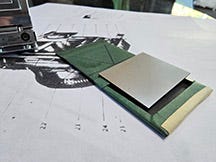
When the package arrived, the surprise turned out to be an original Compass Camera dry plate in a plate holder from 1936.
Built in the 1930’s, the Compass Camera was invented by a guy named Noel Pemberton Billing. Apparently they only made around 4,000 Compass Cameras. Which feels optimistic considering the number of microscopic parts clearly designed to launch themselves into carpet oblivion. Mine is #1282. It’s machined from a solid piece of aluminum. Compact and gadgety, it feels good in the hand – improbably dense, like a Zippo lighter designed by NASA.
The lens telescopes out and locks into place. It’s got a Deco-looking depth of field chart on the built-in lens cover.
The Compass Camera contains more engineering than a Cold War submarine.
It has a viewfinder, a side-viewfinder for spy photography, a rangefinder, a ground glass, a bubble level, an extinction meter and enough tiny knobs, levers and cryptic markings to accidentally launch artillery.
As a guy with a British accent and seriously furry hands stated on YouTube, “All of this crammed into a camera no bigger than a fag packet.”
Here’s the glitch. The camera was originally designed to use little paper, preloaded, glass plate holders. You bought these from the manufacturer, exposed them, and sent them back for processing. A one off. Needless to say, the company is no longer making these glass plates or holders.
Evidently there were aftermarket film backs made for use with 828 film (35mm without sprocket holes). But this particular camera didn’t come with one.
Having an original plate holder turned out to be key. I was able to dissect it. I figured out how it worked and how it loaded.
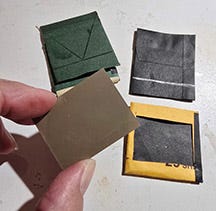
The loading process feels less like photography and more like disarming a bomb in a 1930s submarine movie. Tiny spring ears release the ground glass. A loaded plate holder slips into hidden grooves. Everything clicks into place with Swiss-watch precision — assuming your fingers are the size of uncooked spaghetti.
I began by cutting film to fit the original paper holder. I took a few shots of things around the yard. Success! The camera was making images 90 years after its birth!
Thrilled, I text Ann a couple of photos. After all of the money and thought she’d put into this gift, I see now these results are probably a let down.
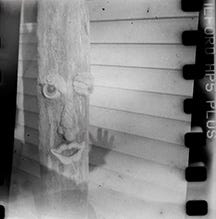
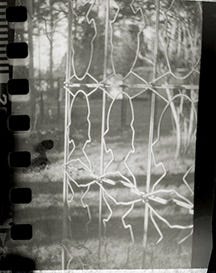
Reusing the paper holder was not ideal. It began to wear and tear. But I persevered. I made another holder out of pieces of a lightproof photo paper envelope. It worked, but barely.
I began to research making dry plates – as originally intended. This is when I came across Zebra Dry Plates in Slovenia. Not only do they sell standard size plates, they’ll cut custom plates as well. Another glitch – the glass plates they use are 2mm. My original is 1mm and the camera will not accept anything thicker. Solution: tintypes. The tintype is less than 1mm thick. So I ordered a batch.
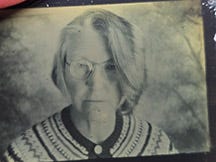
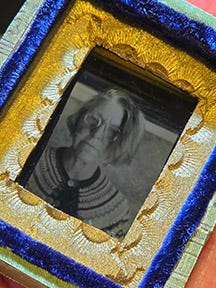
My initial experience with Zebra Dry Plate tintypes was a success, but there was a major problem. The paper plate holders basically shredded. Ah! What about 3D printing these little suckers? Zebra makes custom sized plate holders, so I sent my specs.
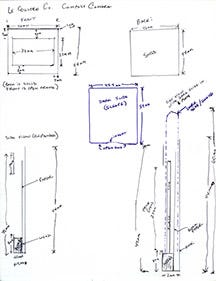
“We can definitely make those for you!” was the answer from Nejc, CEO of Zebra Dry Plates.
Perusing their website some more. Wait! They have workshops? I faffed about – briefly. [No I didn’t.] I’m in! By this point, Slovenia no longer felt optional. I had crossed into a kind of photographic jihad. And THAT, my friend, is why I had 1 hour and 11 minutes until prayer.
Plates had been ordered ahead, plate holders were to be waiting for me. I felt … special.
Coincidentally; Ann had old friends in Slovenia. Mutual followers of Dadaji. Though Ann had not met them face-to-face, they offered me a place to stay. Ann’s friends, Jure and Maja, live a couple of hours from the capitol of Slovenia, Ljubljana.
Ljubljana includes a typical European Old Town area. This is where I stayed. Zebra Dry Plates is located east of the city. I took a bus out to the site. A lovely rural setting – a church steeple at every turn.
Getting a tour of Zebra itself is fascinating. Nejc and crew are innovators. A mix of technical creativity, scientific know how, and entrepreneuring spirit – using modern technology to make a 200 year old process accessible. The enthusiasm is palpable. Friends and family, packaging orders and running large banks of 3D printers. Walking into the print room felt like being inside the Matrix.
I got to spend two days with Nejc, making plates, photographing and developing them … eating lunch with his family and friends.


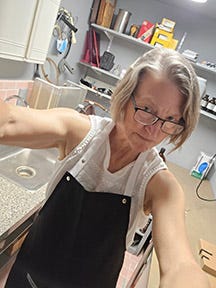
In the end Nejc gifted me a Zebra Dry Plates apron. It meant more to me than any diploma.
Then I was off! Galavanting about the countryside with my newfound knowledge, resources and… many, many second guesses.


Every shot became a negotiation between exposure, optimism, and user error. [User terror?]
I’d set up the shot. Meter the scene. Second guess my metering. Take a photo. Decide it was too long/short. Reshoot the photo … at the last second deciding NO! and adding a few seconds – or 15. Pulling out the plate and accidentally sliding the dark slide up. Accidentally double loading the plate holders (those tintypes are thin!). And so on.
During evenings in Ljubljana, after strolling the riverfront, I read more about Noel Pemberton Billing, inventor of the Compass Camera. I am dead serious, the guy was an f’n nut-job.
Born in 1881, Billing was an aviator, inventor, publisher, member of Parliament and apparently incapable of having a normal afternoon. At thirteen he burned down his headmaster’s office and ran away to South Africa. Later he boxed professionally, won a bet that he could earn a pilot’s license within twenty-four hours of first entering an aircraft, founded an aviation company, designed warplanes, became known as “Minister for Air,” earned a law degree, and then veered hard into paranoid conspiracy territory.
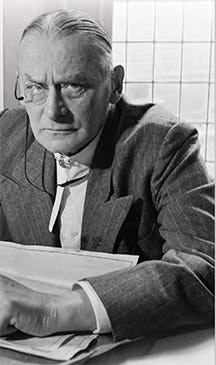
At one point he published claims that Germany was controlling Britain through homosexual seduction rings and warned of a lesbian cabal he called “The Cult of the Clitoris.” Lord Beaverbrook appears in this story somehow, because naturally he does.
The man clearly had several screws vibrating loose. But he also invented an astonishingly weird little camera.
My Compass Camera was quite the little travel companion. The postcard box camera? Well it required the extra large dark bag and postcard-sized glass plates. This meant, when I used the big dark bag for the Compass (because why bring an extra bag?), I’d lose the little holders and have to spend time, rooting around looking for them underneath all of the other light sensitive paraphernalia inside that changing bag hell-hole. While tourists strolled past, giving me the side eye.
I left the city for a few days to visit Ann’s friends, Jure and Maja. They live in Črnomelj in southeastern Slovenia. Jure has erected a wood house he calls the Bee House. He keeps bees, far out of town, on a hill over looking a river, with Croatia in the distance. One Friday evening we wend our way to a restaurant that serves only fried sardines. We eat them whole, heads and all. The Compass sits on the café table between us — this impossible little machine that had somehow crossed oceans, outlived its inventor, survived ninety years, and turned fear into momentum. During our meal, we drink good beer. Jure crafts a cigarette, filling the center with weed. When we leave, Jure takes off down the road like a bat outa hell. Jure is a crazy driver, careening down hilly country lanes – literally “lanes”, as he’s often taking up more than his own. He’s actually a better driver when stoned. He’s told me he doesn’t like silence. It makes him tense. He fiddles with the radio. “I’m looking for an English station.” He finds one. We hit it in the middle of The Cure singing, “It’s Friday. I’m in love!” and we three join in, at the top of our lungs while we weave our way away from the setting sun, back to the bee house
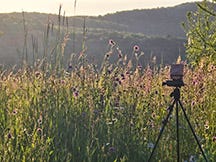
I’ve set up a Zoom meeting with Ann via my phone. Though Jure, Maja and Ann have had a close, though geographically distant, relationship for years, they have never spoken. They’ve never actually met. The Zoom meeting goes well. Jure shows Ann around his bee yard. In the end she brings up how crazy it is that the Compass and I are there.
After a pause, she says, “All of this because I got cancer.”
Weeks later, The Cure’s brain worm remains with me –
“I don’t care if Monday’s blue; Tuesday’s grey and Wednesday too; Thursday, I don’t care about you …”
– I smile every time I realize I’m still singing it to myself.
The Compass had started as a wildly impractical gift during a frightening time. Somehow it became a bridge — between continents, between strangers, between fear and momentum.
The Compass was never really about the camera. It was a strange little machine people kept handing to one another: Boris to Ann, Ann to me, Nejc back to the process itself. A ninety-year-old object that refuses to become obsolete because people refuse to let it. Somewhere along the way it stopped being a gift and became proof — that curiosity can outlive fear, and that sometimes the smallest, strangest objects carry us the farthest.
Back home, I send Nejc a thank-you note:
Amazing story! I got to spend one day in Koper, Slovenia last summer and I immediately wanted to move there permanently.
So cool! What a great story!